Showing posts with label gesamthof. Show all posts

Hedera, a magazine on ecosexuality, transfeminism and queer ecology.

 Hedera is commonly known as ivy, the forgotten names include bindwood and lovestone, as they like to cling to stone walls. There are a lot of misconceptions about this plant, it has been accused of damaging walls and 'being invasive'. This is not very nice gossip by people who don't really know what ivy does and how they grow. In reality, this plant - within their natural habitat - is a very important source of nectar in winter and they are key for the survival of early wild bees. Birds like to eat the berries and make nests in the dense cover of the leaves. All of this to say that we really like the name of the new magazine launched last autumn: Hedera.


This new magazine offers a platform to talk and think about postnatural and transfeminist studies, in essays, fiction, poetry and other forms of conversations observations are shared. The Gesamthof, a lesbian garden is featured in this first issue, you will find the recipe and atlas printed with a beautiful design on the pages between articles on queer feminism.


We would like to thank Zoë De Luca Legge for reaching out to us and including our texts and images, by printing about the Gesamthof we have more evidence that we exist. With Hedera our garden is shared in a different kind of overspill, these are seeds of thoughts. It matters so much because this existence is temporary. Like so many queer projects, the lesbian garden will also disappear when the new owners of the location move in. Queer archiving is incredibly important because equal rights are an ongoing effort, these rights are precarious and need positive energy rooted in generations of activism. Every plant, critter, slug, fungus and other species matters in this more-than-human perspective on a lesbian garden. With Hedera we are entangled in the stories of others, printed on paper, touched by the green fingers of many writers and readers, and greeted by all our antennae and other feelers. Thank you so much! 


Hedera is curated and edited by Zoë De Luca legge, graphic design is by Paola Bombelli, translations and proofreading by Iris Legge, with contributions by Nicky Broeckhuysen, Seba Calfuqueo, Teresa Castro, Marina Cavadini, Eline De Clercq, Zoë De Luca Legge, Alice Fiorelli, Stefanie Hessler, Signe Johannessen, Michael Marder, Pony Express, Pia Riverola, Sacred Sadism, Annie Sprinkle & Beth Stephens, Caitlin Stobie, Cecilia Vacuña. The cover image is by Marina Cavadini, photo by Marina Cavadini and Brando Pizzon, 2019. Printed on recylced paper 'Cocoon Silk'. 

Contact: info@hederamagazine.com 

IG @hederazine
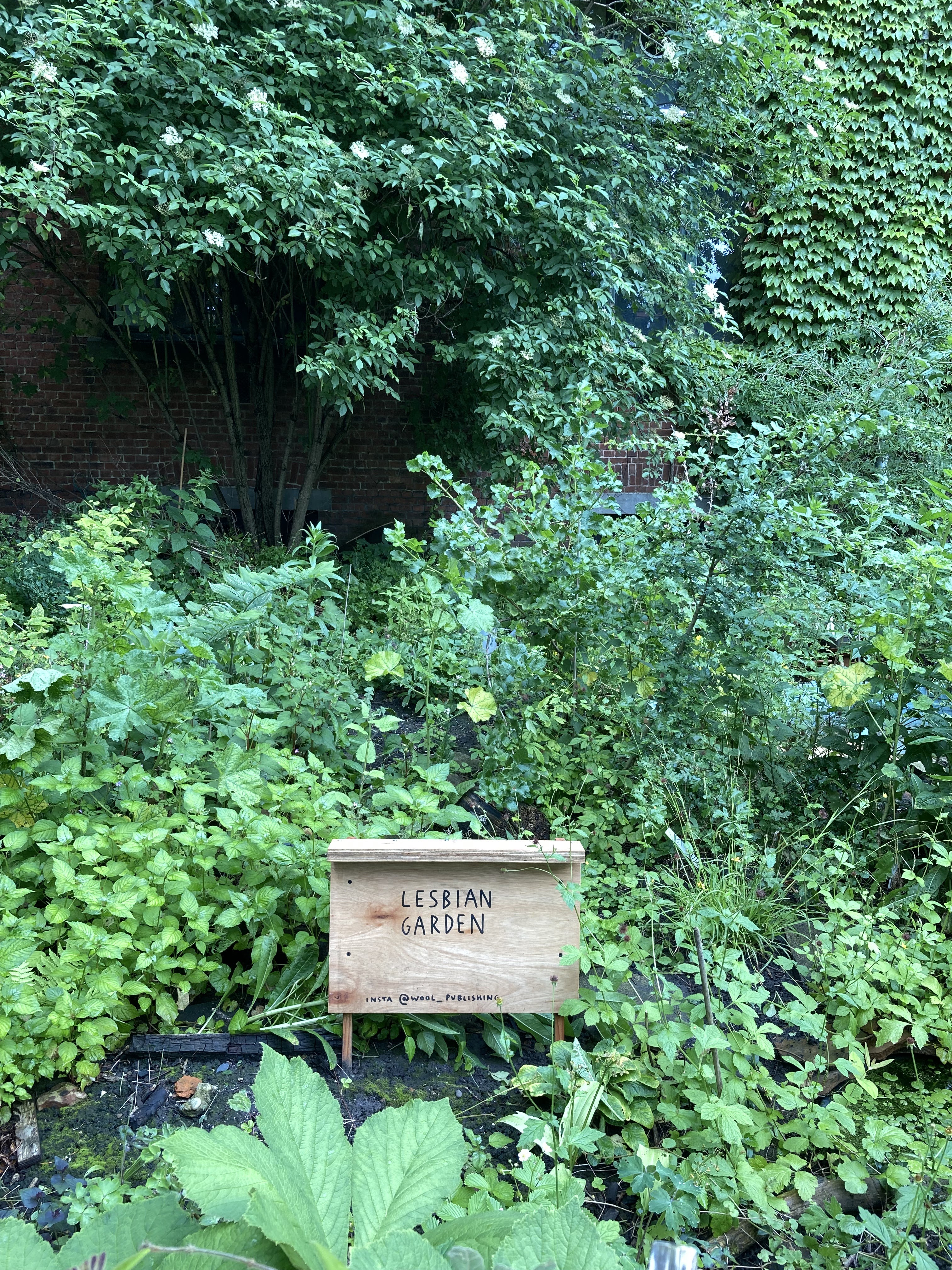


Gesamthof, the lesbian garden, can be visited via the kunsthal Extra City, in Antwerp. https://extracitykunsthal.org/

The garden is part of the monastery garden in the care of Morpho vzw, an organization providing ateliers for artists and organising artistic residencies. https://morphoantwerp.be/

The garden is cared for by many human and other species, the support for this art-nature project comes from many entanglements both within the monastery site and local and far-from-local generous friends.

Premiere Gesamthof / A Lesbian Garden

 On 30 July 2022 Anne Reijniers and me screened our short film Gesamthof / A Lesbian Garden at Morpho in Antwerp. For this event we organized an exhibition by the poet and writer Johanna M Pas, her work brings gender, nature, ecology and being wild together in her poetry. A pop-up stand of LGBTQI+ bookstand Kartonnen Dozen offered feminist literature related to the art nature project Gesamthof, the lesbian garden in the same location. 


We would like to thank everyone who helped to make this empowering and caring event, a big thank you to the wonderful public who came the create a very diverse community for the evening and thank you Johanna M Pas, Terre & Sym, Morpho, Extra City and The Sore Spot Singers. 


If new screenings are planned, they will be announced on this website. A very warm thank you from both Anne Reijniers and me.


Photo by Miles Fischer, Anne Reijniers and me at the projection on the wall in the cinema by Morpho

 
Setting up the cinema at Morpho, it turned out the option to add more chairs was a good idea.

The exhibition with poetry by Johanna M Pas in the beautiful old refter of the monastery.

The poem by Johanna M Pas is also translated by her.

Johanna M Pas writes about gender, identity, nature, ecology and feeling home.

Terre organised the pop-up bookstand by Kartonnen Dozen, the oldest lgbtqi+ bookshop in belgium.


Gesamthof / A Lesbian Garden


Premiere short film (15', 2022)

Screening at MORPHO on 30 july at 21:30h, entrance via Extra City, Provinciestraat 112
 
Anne Reijniers & Eline De Clercq invite you to the premiere of their short film Gesamthof / A lesbian garden, an art - nature project in the monastery garden of Extra City and MORPHO. In this time document of the garden we follow a tour with Eline De Clercq and the MORPHO artists in residence. The garden provides an entry point to talk about diverse topics such as colonialism in botany, the ambiguity of naming, the social expectations of women and the search for a lesbian identity.
 
Anne Reijniers and Eline De Clercq are both artists and gardeners living in Antwerp. Anne Reijniers is part of the filmmakers collective 'Collectif Faire-Part' and participated in MORPHO's development residency in 2021. Eline De Clercq is a visual artist, painter and rents a studio at MORPHO in Ploegstraat since 2019 when she also started to work in the monastery garden.

The film shows the Gesamthof, a lesbian garden - including trans people -  inspired by the books of Donna Haraway, Anna Lowenhaupt Tsing, Jamaica Kincaid, Robin Wall Kimmerer, Ursula Leguin and many other thinkers who are working on togetherness in the Plantationocene. The Gesamthof puts thoughts into tangible practice: Haraway's queer kinship, speculative fabulations, situated knowledge and Tsing's explanation of a complex patchy capitalism and the human aspect into the restoration of post-industrial land as well as being part of the ecology. In the garden we see how compost works, what soil can do and how a pine tree is a great pioneer. In the film we document the garden and our place in it along the garden path. The tours that are given in the garden activate the stories that are shared between the human and nonhuman inhabitants. 

The temporary nature of the garden, the residents and the project, gives this short film an urgency. We don't know how long we can stay at this location, and climate change is happening now, both makes us feel like we have to keep working at a better understanding of what ecology means in a multilayered compost.

There is an entire page on the garden project, with old photos, new images and where you can read the garden recipe: 

https://elinedc.blogspot.com/p/the-gesamthof.html

or follow on instagram for updates @wool_publishing

Film still from 'Gesamthof / A Lesbian Garden 2022 on being useful.


Film still from 'Gesamthof / A Lesbian Garden 2022 on how to begin.


Film still from 'Gesamthof / A Lesbian Garden 2022 how to find plants.


Film still from 'Gesamthof / A Lesbian Garden 2022 on new names for old plants.


Film still from 'Gesamthof / A Lesbian Garden 2022 on the archeology of the soil.


Film still from 'Gesamthof / A Lesbian Garden 2022


View on the lesbian garden from the studio by Eline De Clercq


Artemisia


Artemisia

 We might think of gardening as a romantic past-time. Yet, gardening has been an important tool for colonialism and possession, but also emancipation. Eline De Clercq (°1979, BE) created a lesbian Gesamthof in the monastery garden of Kunsthal Extra City and Morpho. As plants are non-binary, the garden is a safe space for lesbians. She brings together a community of humans and non-humans to work together with care for their ecology. For this exhibition, Eline selected accessible medicinal plants from the garden to reveal class issues in an intersectional context. Medical care in most countries is still reserved for those who can afford it. This selection of plants thrive everywhere and are freely available in the wild, even in urban areas. Historically, they are used to heal female or othered bodies. Eline's curation culminates in the presence of Artemisia, which grows all over the globe and is used against illnesses like malaria. In some cultures, it is known to cure hormonal imbalance and induce natural abortions, but when doses incorrectly it is deadly poisonous. The plant is an illustration of the dangers female bodies go trough as a result of inequality and sexism, but also becomes a symbol of freedom. With the growing world-wide criminalisation of abortion and the endangered Roe vs. Wade court rule in the US today, Artemisia might even be a symbol for the fight for self-determination and equal rights in the 21st century.

Text by Zeynep Kubat


Artemisia is an installation of plants and fabrics in Sugar for the Pill: plants from the lesbian Gesamthof, 2022. Artemisia Vulgaris, Salvia Officinalis, Mentha Citrata. Wool fabric on a cotton rope with a depiction of the goddess Artimisia on one side and the leaf of the Artemisia plant on the other side in oil paint. Cotton fabric on the wall with text informing about the plant, the use, the religion and other abortifacient plants, with a danger warning all written in oil paint.


Sugar for the Pill is a group exhibition curated by Zeynep Kubat and my work was shown alongside the works of artists Margaux Schwarz, Laurie Charles, Chantal van Rijt, Lysandre Begijn, Saddie Choua, Aurélie Bayad, Carole Mousset, Lisa Ijeoma, Pélagie Gbaguidi.


Image: Axelle Degrave


Image: Axelle Degrave

Image: Axelle Degrave


Sugar for the Pill


Antwerp Art Weekend 2022 central exhibition Sugar for the Pill, curated by Zeynep Kubat.