Showing posts with label art history. Show all posts

Artemisia


Artemisia

 We might think of gardening as a romantic past-time. Yet, gardening has been an important tool for colonialism and possession, but also emancipation. Eline De Clercq (°1979, BE) created a lesbian Gesamthof in the monastery garden of Kunsthal Extra City and Morpho. As plants are non-binary, the garden is a safe space for lesbians. She brings together a community of humans and non-humans to work together with care for their ecology. For this exhibition, Eline selected accessible medicinal plants from the garden to reveal class issues in an intersectional context. Medical care in most countries is still reserved for those who can afford it. This selection of plants thrive everywhere and are freely available in the wild, even in urban areas. Historically, they are used to heal female or othered bodies. Eline's curation culminates in the presence of Artemisia, which grows all over the globe and is used against illnesses like malaria. In some cultures, it is known to cure hormonal imbalance and induce natural abortions, but when doses incorrectly it is deadly poisonous. The plant is an illustration of the dangers female bodies go trough as a result of inequality and sexism, but also becomes a symbol of freedom. With the growing world-wide criminalisation of abortion and the endangered Roe vs. Wade court rule in the US today, Artemisia might even be a symbol for the fight for self-determination and equal rights in the 21st century.

Text by Zeynep Kubat


Artemisia is an installation of plants and fabrics in Sugar for the Pill: plants from the lesbian Gesamthof, 2022. Artemisia Vulgaris, Salvia Officinalis, Mentha Citrata. Wool fabric on a cotton rope with a depiction of the goddess Artimisia on one side and the leaf of the Artemisia plant on the other side in oil paint. Cotton fabric on the wall with text informing about the plant, the use, the religion and other abortifacient plants, with a danger warning all written in oil paint.


Sugar for the Pill is a group exhibition curated by Zeynep Kubat and my work was shown alongside the works of artists Margaux Schwarz, Laurie Charles, Chantal van Rijt, Lysandre Begijn, Saddie Choua, Aurélie Bayad, Carole Mousset, Lisa Ijeoma, Pélagie Gbaguidi.


Image: Axelle Degrave


Image: Axelle Degrave

Image: Axelle Degrave


Sugar for the Pill


Antwerp Art Weekend 2022 central exhibition Sugar for the Pill, curated by Zeynep Kubat.


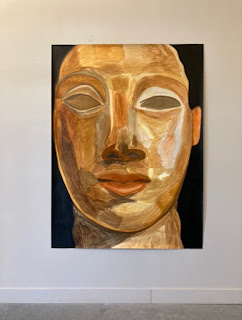
Portrait of a Korè


Portrait of a Korè.


You are looking at a painting of a polychromos sculpture; the missing colour of the Greek marble statue has been re-imagined in this portrait. The colour on the sculpture is closer to the truth than the white marble. We are in Archaic Greece, some 3,000 years ago. A group of young sculptors-in-training travel to Egypt to learn the trade, and they bring the Egyptian style of sculptures with them to Greece. The typically large Egyptian sculptures with a rigid stance have become more flexible, rounded and human in Greece. Egyptian art is made for eternity and Greek art is made to be seen among people, in the midst of life. The Archaic smile that brings the sculpture to life attracted me. This smile is often found in my paintings. I draw inspiration from Herbert von Buttlar's 1950 book "Griechische Köpfe,". The peplos korè is a freestanding statue carved in stone. The korè statue represents a young woman who died before she could be given away in marriage. Korè means "daughter," and the statue is a funerary monument that greets the living along the access road to the city or to a temple. No two korè statues are alike, and each has individual characteristics in style, posture, dress and face. They are not depicted naked but wear a beautifully decorated colourful peplos, a wool robe. Greek statues were always painted. The white marble statue is the substructure, and without paint it is incomplete. Colour was expensive, and a statue richly decorated with lots of colour showed that a korè belonged to a wealthy family. The statues that stood in the open lost their colour, but those that were excavated have mostly been able to retain the colour. After the Persian War in 480 BCE, many of these statues were buried in the sacred ground of the Acropolis, where they were excavated in the 19th century.


The korè statues were made in a transition period from an ancient Eastern culture to a new Western culture. In the East, women had important roles such as amazons, priestesses, and goddesses who watched over women's health. In ancient times Greek culture changed from East to West within the same geographical place. The mythical stories do away with the old Eastern influences to make way for a new form of thinking. In the 6th century BCE Greece changed towards democracy, patriarchy, money with coins minted by polis, laws written down and the slave trade was an essential part of the economy in the Athenian empire during the Attic-Delian League. Slavery was an economy model, every family owned slaves to do the work for them. Athens had slaves in the silver mines and in the administration, working for the men who invented the foundations of European philosophy, arts and sciences. Along with these new thinkers came the new myths tailored to the new society. For example, Athena is born from the head of Zeus, a woman who comes into the world immaculate. Athena with her owl is a woman conceived by men: she is heroic, has a helmet and spear, and is not afraid to go to war. The opposite is the much older titan Medusa, a woman who can turn people into stones by just looking at them. The animal worshipping Medusa was transformed from the Eastern style of Potnia Theron and Ishtar into an ugly monster that wouldn't listen to reason and was murdered by Perseus.


The clear eyed, divine and warlike Athena also stands in stark contrast to the korè. The real korè, as a daughter, lives at home with her parents in ancient Greece and witnesses a culture where women have no voice. Women literally had to remain silent. They are not allowed in the agora. They must stay in the house except to fetch water or clean the family tomb. In public, they must be veiled. Their work consisted of weaving and taking care of the children. Only priestesses and prostitutes are allowed to participate in public festivities and they have a little bit more freedom. Women are not allowed to study, they are not allowed to attend symposia, they are not allowed to speak up in public, and men are not encouraged to speak about their wives either so that every trace of their voices disappears. These women have nothing to decide for themselves and are under the guardianship of their father, husband or brother.  


On April 24, 1921, women were allowed to vote for the first time in Belgium, giving them their own voice in our democracy. The equal right to vote for women dates back to 1948, when they were given the same right to vote as men. 


A text to go with the painting 'Portrait of a Korè' made in 2021 for WARP, exhibited in Madonna's Web.

For further reading: Peter Hunt, Ancient Greek and Roman Slavery, 2017, Wiley-Blackwell; and Mary Beard, Women & Power, 2017, Liveright.


Study for sculpture with painting, coloured Kore portraits. 2020

These studies on paper are searching for ways to present the classic kore sculptures in colour. The white stone surface is replaced by an imagined coloured portrait.

Oil paint on paper, 46 x36 cm, 2020


Oil paint on paper, A4, 2020


Oil paint on wood-board, 30 x 20 cm, 2020