On 17 March I was invited by Extra Academy to talk about my artistic practice in Het Bos, an art and culture organisation, community and workspace in Antwerp. Usually I present my work in duo shows or group shows with other artists, but here the invitation was not about my work but about my practice. There is a slight difference and to further complicate matters my practice is part of my work and the other way around as well. I consider art not to be limited to objects, it's an interaction, a practice, a meeting, a conversation, a sketch, an investigation, a research opening up new possibilities and far from restricted to material bounderies.
 |
One view of the room, with the flag 'Abortion is Health Care', the screen with photos of trees in botanical gardens and the set up with carrier bags.
|
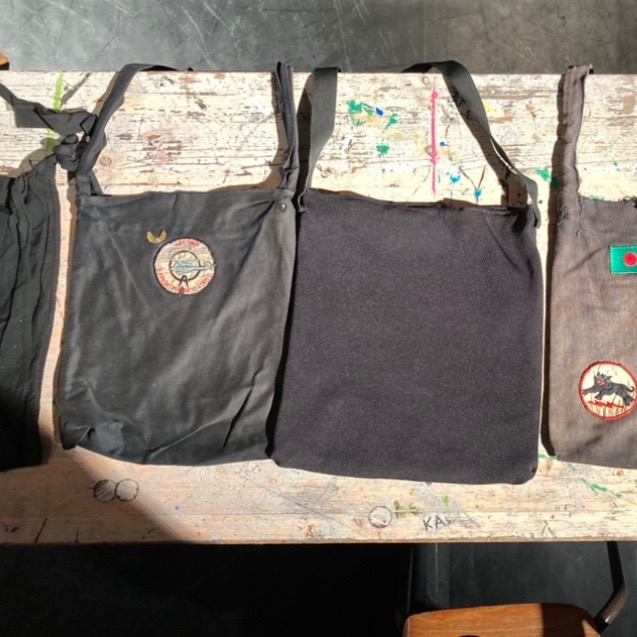
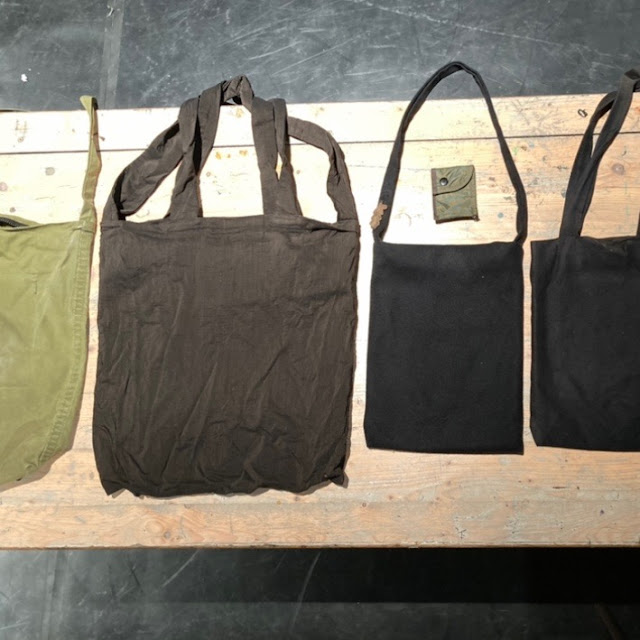
This talk is based on The Carrier Bag Theory of Fiction by Ursula Le Guin, an essay that has become the mycelium network in my day to day artistic work, together with many other texts and books. Since the early 2000's I have been sewing my own carrier bags in order to find a more gender neutral and utterly practical sollution to replace 'handbags'. These wool and cotton bags are a collection of travels and experiences. When they would fall apart I made a new one whilst finetuning the design to fit my life. There are hidden pockets, metro card holders, pouches for pencils and a lining the same length of my outstretched arm.
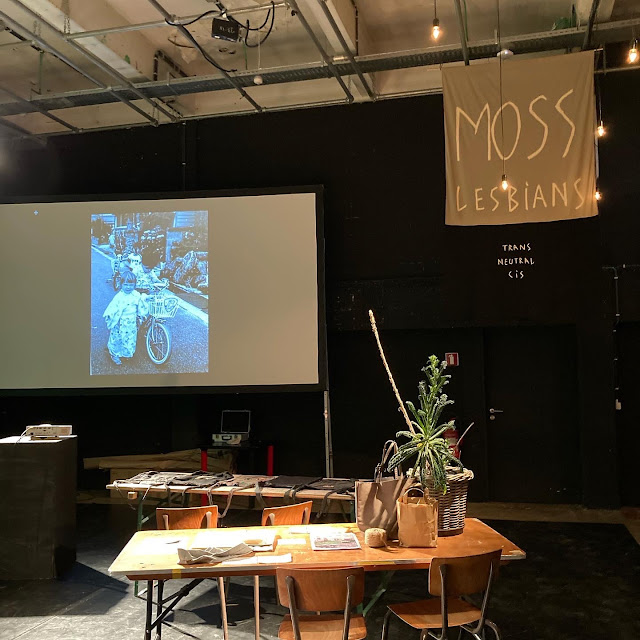 |
The other view of the room with the presentation of practice, the garden plant and the flag 'Moss Lesbians, trans neutral cis'.
|
The presentation in the room is an intersectional set up of two screens, two cinema set -ups crossing each other with the screens meeting in the corner. The aim was to give a visual intersectional experience: sit on one side and you see one screen, sit in the cross section and you can see both. The audience in the 'regular' seats looked at my collection of photographs of botanical gardens, with a focus on trees. The audience in the garden chairs set on the stage looked at the photo presentation of my artistic practice.
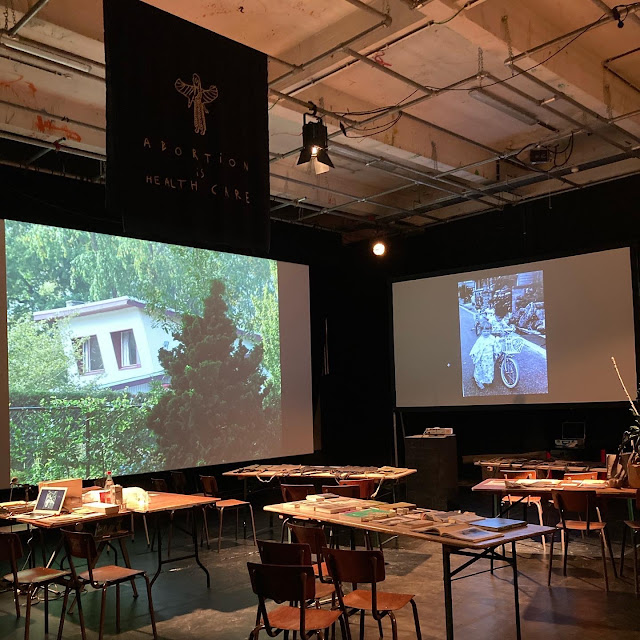 |
An intersectional view of the room with the two screens in sight.
|
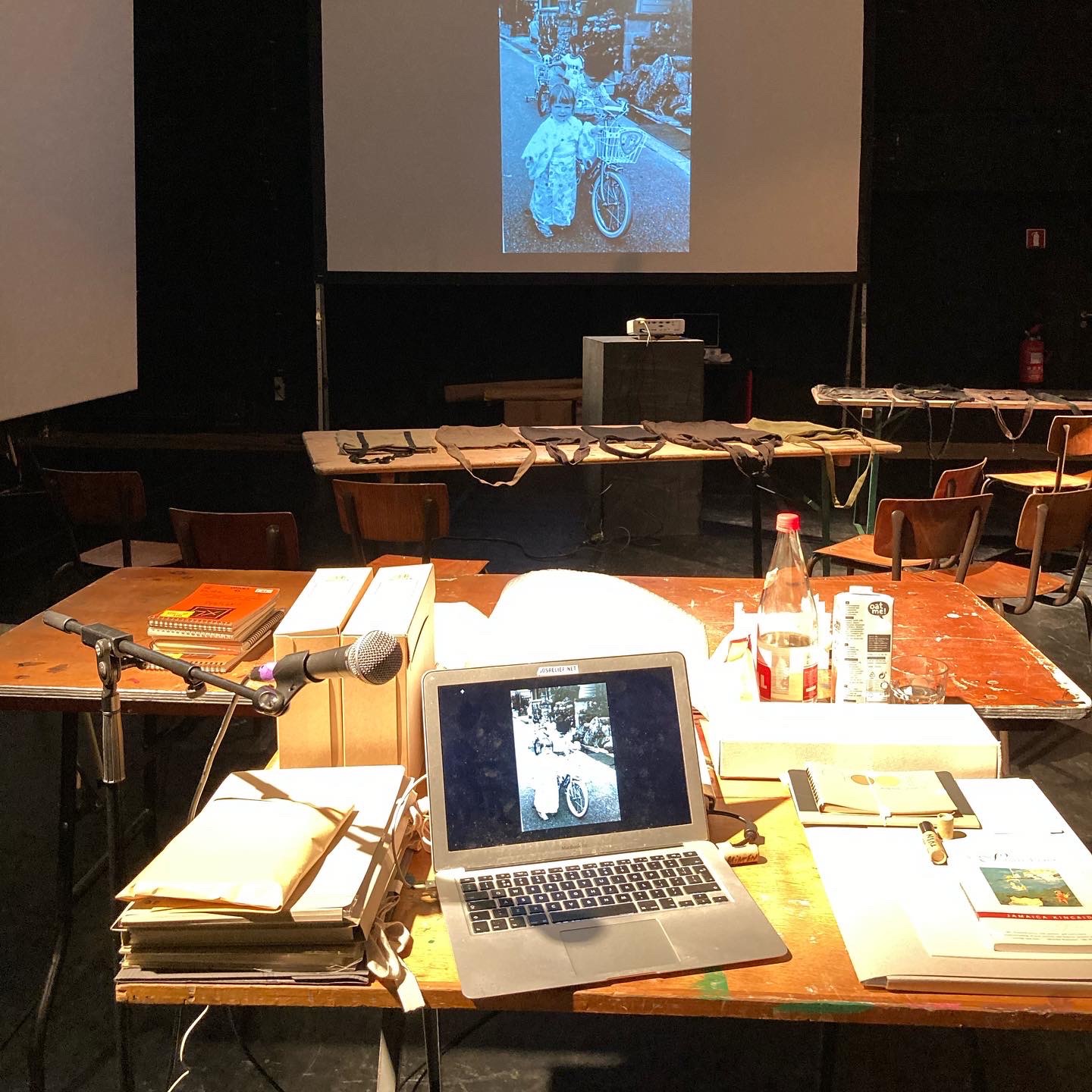
I started the talk with how I grew up in an environment of cultural appropriation, my parents studied macrobiotics and I never knew what a 'normal' Flemish youth was like. I was 27 when I first entered a chip shop to buy fries, I grew up with miso soup and mochi instead. The photo I chose to go with this talk was taken in Japan when I two years old. I was dressed up in a traditional Japanese yukata, and if today I would wear a kimono in the supermarket in Antwerp people might think me strange but in this photo it is accepted because of 'tourism' and the general normalcy of white people who like to wear clothes from other cultures. While I grew up in an extreme kind of cultural appropriation, it has become more and more clear to me that culture in Europe, Belgium and Antwerp is so mixed up in cultures from others that we don't know what would be left if we stripped it all away. And where to start? With the Romans? Hasn't Antwerp always been a harbour city, a mix of cultures? My question is, what were we before we were colonial powers? And when did this start? What is left of this and can we ever untangle this or is this part of our identity?
 |
The photo to start talking about cultural appropriation.
|
The other less visible but just as strange appropriation in the photo is the gendered clothing, wearing girl clothes was fitted onto me as much as the foreign culture. I grew up thinking children became woman or man overnight and it scared me terribly. From my environment I could tell I was 'girl' going to become 'woman' with a program attached to this gender. I had other plans and from early age I trained myself to remember 'me', to remind myself in the evening before falling asleep "Don't forget who you are. Never forget. You are not like this boy or girl." The overnight change didn't happen, but I did learn that it was easier to pretend, to play along, and it didn't even bother me that much. I liked dressing up in all kinds of manners, what bothered me was that when I made a painting it became part of the gendered art field, and I couldn't escape this general story of Art. I needed to make a different story where my art makes sense, where a portrait of a lesbian is made for lesbians and where a community garden is made with a multispecies community. Looking for answers I looked at nature, where making sense (literally, the senses) is at the heart of everything however strange it might look. In nature 'woman' can be everything, and so can 'man' and every other option, words often lack and labels are written in a puzzled binary; but really looking at plants, animals, fungi and more we can clearly see there is more freedom than a simple 'yes' or 'no'. My pronouns are she / her on the condition that this can mean everything, and very often I will use 'we' because I identify as part of natural ecosystem. We are gardening together.

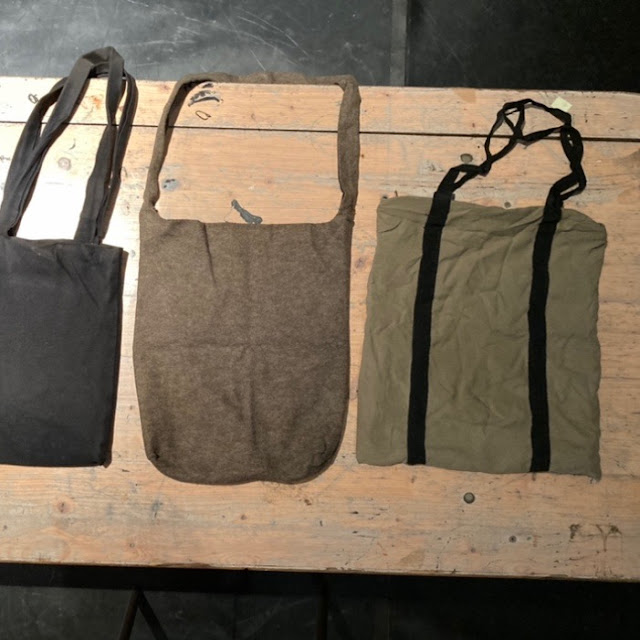 |
The many carrier bags I hand made to find something to wear that is gender neutral.
|
To make this new, different, story I started to read into the gaps and folds of the old story. Virginia Woolf writes about how new words don't make sense in old languages and even would destroy sentences, she gets at the heart of this friction in the only surviving audio recording of her voice. Here's a quote of this text:
"In order to use new words properly you would have to invent a new
language; and that, though no doubt we shall come to it, is not at the
moment our business. Our business is to see what we can do with the
English language as it is. How can we combine the old words in new
orders so that they survive, so that they create beauty, so that they
tell the truth?"
Read the full text here on the wonderful website The Marginalian.
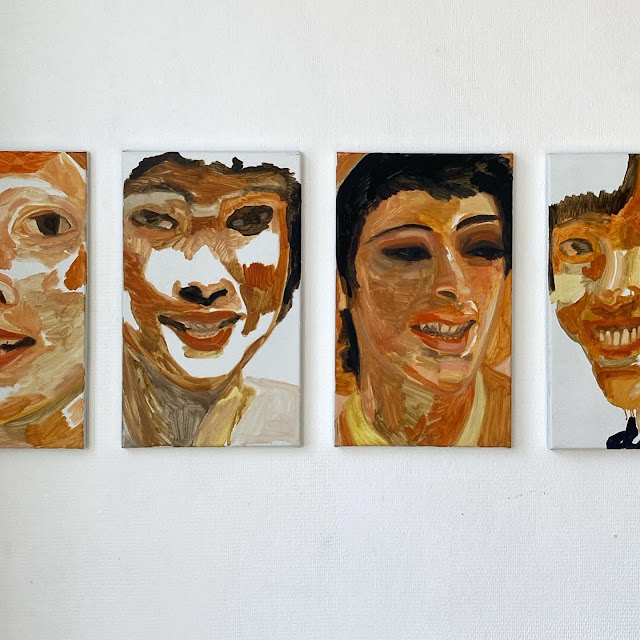 |
The lesbian, non binary and trans portraits presented at BRAVE art space.
|
I'm a painter, but my business is to see the invisibilized fragments that didn't fit in the old language. In the old art history books I could find clues on what might have been unnoticed, like the child underneath the clothes, and I started to extend my practice with a critical reading of European art history. The Carrier Bag Theory generously tells about how art history was constructed, how the timeline like a spear or arrow pierced the pages of beginning - middle -end. I stepped aside and looked from a different perspective. I'm not inventing new words or languages, I'm questioning the motivation behind strange conclusions in art history.
The labyrinth
Many of you know the labrinth in the garden, a series of shrubs cut into a game of hide and seek. Every opening leads to a new choice: left or right? This is not at all like the labyrinths from the time of Ariadne and Theseus, classical labyrinths didn't offer any choices in left and right. There is only one way all the way to the end. The labyrinth leads to the Minoan monster in the middle, and if anything it is a metaphore of life and the inevitable fate coming sooner or later. When you look at the old labyrinths this is clear, but what is then the story of Ariadne? Why did she give the wool thread to Theseus? Obviously he could find his way back, there is only one way. Is the real story here that he is not alone, that she doesn't abandone him in this peril? Are they bound in fate? Because if he can get out, so can the Minotaur. That would make a different story, she would be much more than just a love interest. And it would make more sense towards the end, because the story continues: after he returns he leaves her for someone else. Has history erased Ariadne's true act of giving a thread?
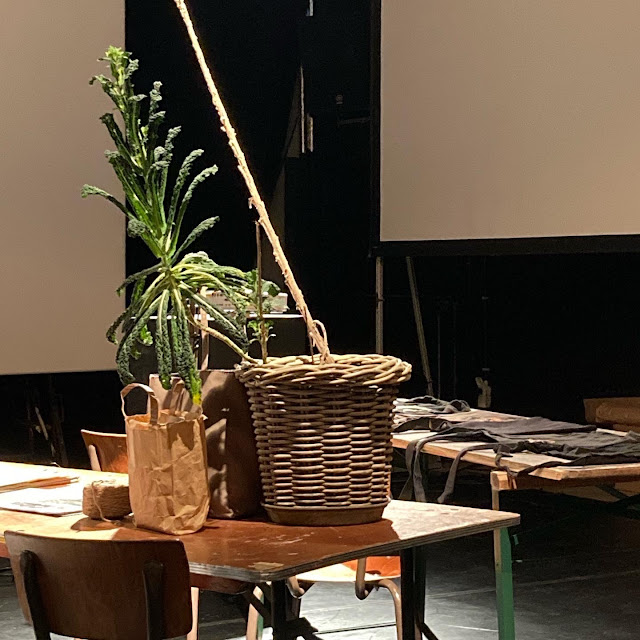 |
The garden table, with plants, seeds, a piece of string and many plans.
|
Dulle Griet / Mad Meg
Many years ago I emailed the museum Mayer van den Bergh to notify the mistake in a title. The painting by Pieter Bruegel 'Dulle Griet' or 'Mad Meg' has a label that explains she's a mad woman stealing from hell. This title and explanation of the work was given by Karel van Mander in 1604, many years after Bruegel died and based on his own conclusions after he discovered the word 'dulle' ( mad) in the painting. While I walked past this painting in the museum I couldn't help wondering why a thief would steal a cast iron frying pan. These objects are very heavy and she's out of breath running up a hill with lots of other heavy objects. This painting is not making sense. Together with my friend art historian Suzanne Duff I sat down and we looked at this work properly. We read the painting outside of the given context and drew completely different conclusion. This work was about war, protecting belongings, taking up arms in haste, misconduct of people in charge and it all took place in a city with a harbour. Bruegel lived in Antwerp and moved to Brussels, Antwerp was a city where the boats would arrive and where the Spanish fought hard and conquered. This old woman with a bride's veil and soldier's clothes wasn't stealing, she was most probably a refugee. Bruegel was known for his strong opinions and he asked his wife to burn all his notes after his death so his family wouldn't get in trouble. We will probably never know how he intentioned this painting. But for sure no painter would make the mistake to depict a thief stealing a common iron frying pan together with more important heavy belongings. Since then a restauration of the painting revealed the word 'dulle' was not part of the original painting and the label by Karel van Mander is considered faulty. Unfortunately the Wikipedia page in Dutch hasn't been updated yet and still explains the misogynistic view of the earlier label.
 |
The book table with many curious questions, inspiring writers and icons in the arts.
|
More of these curious notions followed, like the ceramic vase that was used to catch an octopus (drop the vase on a string into the sea, the octopus makes a home in this vase, 'fish' the vase up again) and the maritime Minoan vases that are possibly inspired by this way of fishing. At the end of the talk we watched the short film by Anne Reijniers and me: Gesamthof / A Lesbian Garden. The whole event was an interesting experience, this was the first time I could use projections of photography in my work and I enjoyed making this set up. Thank you so much to everyone who helped to make this work. Many thanks to Het Bos and to Nico Dockx for Extra Academy.